


Last reviewed July 2026 using Maine Public Utilities Commission rules, Maine Department of Energy Resources updates, Maine Attorney General guidance, utility rates, and federal tax-law changes.
 Quick Answer: No active Maine or federal program gives homeowners free rooftop solar panels in 2026. Most “free solar” offers are $0-down loans, leases, or power purchase agreements (PPAs). They remove the upfront payment—not the total cost—so your actual savings depend on the provider’s charges, ownership terms, and remaining utility bill.
Maine’s high electricity rates make $0-down solar attractive. Residential electricity averages 30.34¢/kWh statewide, and typical monthly bills can run from about $168 in CMP territory to $184 in parts of Versant territory.
A legitimate offer should disclose the cash price, financed price, monthly payment, rate escalator, ownership terms, and charges that remain on your utility bill. An advertisement claiming that Maine selected your town for free government solar is a warning sign.
Key Takeaways:
- Verify government claims. Maine Solar for All is not accepting applications, so confirm any advertised program through an official
.govsource.
- $0 down does not mean $0 total. You repay the cost through a loan, lease payment, or PPA rate.
- The former 30% homeowner federal credit ended for systems completed after December 31, 2025. A third-party owner may still qualify for the business-side Section 48E credit.
- Maine’s rooftop net energy billing remains valuable. Credits appear on the participating utility account, while the contract determines your actual savings.
- Approval does not prove value. Add the solar payment to every remaining utility charge before comparing the offer with your current bill.
Find out if you're eligible for $0-down solar in Maine!
Is There a Government Program for Free Solar Panels in Maine?
No active Maine or federal program currently installs free rooftop solar panels for homeowners.
Searches for Maine free solar panel programs often lead to private financing advertisements rather than an active government benefit. The Maine Attorney General has warned residents about ads implying that the state selected particular counties, towns, or neighborhoods for free solar.
What Happened to Maine Solar for All?
Maine was awarded $62 million through the federal Solar for All initiative. The proposed program was expected to help more than 20,000 low-income households save approximately $380 to $1,400 per year through rooftop solar, storage, cooperative projects, and community solar.
The EPA terminated Maine’s award in August 2025. The Maine Department of Energy Resources disputed the decision and began evaluating next steps, but there is no active homeowner application as of July 2026.
Until an opportunity appears on an official .gov page, do not provide personal information to an advertisement claiming to enroll households in Maine Solar for All.
Free Government Solar vs. Private Solar Offers
Option | How It Works | Maine Status |
|---|---|---|
Government Solar Grant | Public funding covers some or all costs | Not open as of July 2026 |
$0-Down Rooftop Solar | Private loan, lease, or PPA | Available if you qualify |
Community Solar | Off-site project provides bill credits | Existing-project capacity varies |
What “Free Solar Panels in Maine” Really Means
“Free” normally describes the upfront payment, not the equipment. Panels, inverters, racking, wiring, permitting, and installation labor all carry a real cost.
What a Typical $0-Down System Still Costs
The representative Maine system in this analysis looks like this:
| Typical Maine System | Estimate |
|---|---|
| Monthly Electricity Use | 550 kWh |
| Solar System Size | 4.8 kW |
| Cash Price | $14,430 |
| Price per Watt | $3.00/W |
| Upfront Payment | $0 with approval |
Source: EcoGen Solar Cost Index, July 2026. Representative 4.8 kW system sized to approximately 550 kWh of monthly household use; actual proposals vary.
That $14,430 does not disappear. A loan turns it into a financed balance, a lease incorporates it into fixed payments, and a PPA builds it into the rate charged for each kWh produced.
The complete picture of what a Maine solar system costs depends on the roof, equipment, utility territory, interest rate, and contract term.
How Maine Net Energy Billing Affects the Offer
Under 35-A M.R.S. §3209-A, the Maine PUC’s net energy billing rules provide kWh credits on the participating customer’s utility bill for qualifying rooftop exports. Unused credits can roll forward for up to 12 months.
If you own the system, you control the equipment and receive the bill offset directly. With a lease or PPA, the provider owns the equipment while credits may still appear on your utility account. The provider’s charges determine how much of that bill value becomes real savings.
Will Solar Eliminate the CMP or Versant Bill?
Usually not. Net-energy-billing credits can offset eligible usage charges, but fixed charges remain. You may also owe a loan payment, lease payment, PPA charge, or community-solar bill.
To test the savings, add the solar payment to what remains on the utility bill and compare that total with what you pay today.
Why $0-Down Solar Changed in Maine in 2026
Two developments reshaped the market: the end of the homeowner federal credit and higher utility rates.
The 30% Homeowner Federal Tax Credit Ended
The federal residential solar credit under Section 25D no longer applies to systems completed after December 31, 2025. Paying a deposit in 2025 does not preserve it when installation finishes in 2026.
For the representative 4.8 kW system, the change adds about $4,330 to the homeowner’s net cost: from $10,100 after the former credit to the full $14,430.
Lease and PPA providers may still claim the business-side Section 48E credit as the equipment owner. That benefit reaches you only indirectly through the contract price.
CMP and Versant Rates Remain High
As of July 1, 2026, Maine’s all-in delivered residential rates are:
| Maine Utility | July 2026 Delivered Rate |
|---|---|
| CMP | 24.58¢/kWh |
| Versant—Bangor Hydro | 30.35¢/kWh |
| Versant—Maine Public | 29.66¢/kWh |
High rates can make a discounted solar payment attractive, but the offer must work over its full term—not only against today’s bill.
Solar Loans vs. Leases vs. PPAs in Maine
All three options can remove the upfront payment. The differences are ownership, payment structure, maintenance, transfer rules, and long-term value.
Solar Loan: You Own the System
How it works: A loan finances the equipment, and you own it from installation. Ownership lets you claim the property-tax exemption and control maintenance, equipment, and eligible battery-program decisions.
Main tradeoff: A 2026 loan finances the full eligible purchase price without the former homeowner credit. After payoff, you retain the system and its future production value.
Solar Lease: Fixed Payment, Provider Ownership
How it works: The provider owns the system and charges a fixed monthly lease payment. Monitoring and maintenance are generally provider-managed.
Main tradeoff: You give up ownership-based benefits. When selling the home, the lease usually must transfer to a qualified buyer or be bought out.
Solar PPA: Pay for the Electricity Produced
How it works: The provider owns the system, and you pay a contracted rate for each kWh it produces. The starting rate is normally presented as lower than the utility rate.
Main tradeoff: Many PPAs increase the rate by 1% to 5% annually. Because Maine’s Standard Offer can fall as well as rise, compare the PPA in year 1, year 10, and year 25.
Maine Solar Loan vs. Lease vs. PPA Comparison
Feature | Solar Loan | Solar Lease | Solar PPA |
|---|---|---|---|
Upfront Cost | $0 if approved | Usually $0 | Usually $0 |
Owner | You | Provider | Provider |
Payment | Loan + interest | Fixed monthly fee | Rate per kWh |
Maine Benefits | Owner benefits | Contract-based savings | Contract-based savings |
Maintenance | You | Usually provider | Usually provider |
Home Sale | Address loan | Transfer or buyout | Transfer or buyout |
Best Fit | Long-term ownership | Predictable payment | Pay for production |
Bottom line: A loan offers the highest potential long-term value if you can carry the payment. A lease prioritizes predictable payments and provider-managed maintenance. A PPA depends heavily on its starting rate and escalator.
Who Qualifies for $0-Down Solar in Maine?
Approval depends on the applicant, property, electricity use, and provider. It is not a government benefit and does not guarantee that the contract will save money.
A typical applicant needs:
- Authority to install equipment on the property
- A roof or ground-mount location with sufficient life, structure, and sunlight
- Enough electricity use to justify the system
- Acceptable credit for the selected financing product
- A compatible utility account
- A contract with realistic production and cost assumptions
Credit and Payment Requirements
Providers commonly look for a credit score around 660 or higher, with stronger applicants receiving better terms. You may qualify below that threshold, but a higher rate or less favorable contract can consume the projected savings.
Roof Condition and Maine Snow
Maine roofs must carry panel weight plus winter snow load. A contractor should evaluate the roof’s remaining life, structural capacity, pitch, orientation, and shading.
Snow cover may reduce winter production by 5% to 12%. A clear, well-oriented roof with a pitch that helps shed snow can reduce the risk of overstated savings.
Utility and Property Fit
CMP and Versant support residential net energy billing; municipal-utility and co-op customers should confirm local rules. The installer generally handles interconnection and electrical approval. Maine law also limits outright HOA or local solar bans, although reasonable health, safety, and historic-preservation restrictions may apply.
Maine Solar Incentives for $0-Down Systems
Maine has no state rebate that pays for a residential panel installation in 2026. The remaining benefits are narrower and often depend on ownership.
Maine Property-Tax Exemption
Maine exempts 100% of the qualifying home value added by a solar system under the Renewable Energy Investment Exemption. Homeowners apply through the local assessor by April 1.
The exemption benefits homeowners who own the equipment. It generally does not provide a direct homeowner benefit when a lease or PPA company owns the system. See the full Maine incentive stack for more detail.
Maine Sales Tax on Solar Equipment
Maine does not currently provide a residential solar sales-tax exemption. The former exemption was repealed, and the current version of 36 M.R.S. §1760 contains no enacted solar provision. Maine’s general 5.5% sales tax therefore applies.
If an installer advertises “tax-free solar,” ask whether the claim refers to property tax rather than sales tax.
Efficiency Maine Battery Payments
An eligible paired battery may earn up to $160/kW-year through a participating provider. This is a battery-program payment—not a rebate for free solar panels—and eligibility varies.
Can Maine Renters Use Community Solar?
Community solar does not install panels on a renter’s home. You receive utility-bill credits from an off-site project and usually receive a separate bill from the project provider.
Maine stopped utilities from entering new net-energy-billing agreements with certain new distributed generation resources after December 31, 2025. That restricted new development, but it does not necessarily prevent every grandfathered project from serving or enrolling customers. Availability depends on whether an existing project has open capacity and whether you qualify under its contract.
Before enrolling, verify Maine PUC registration, the advertised discount, separate billing, cancellation terms, and annual credit expiration. The Maine Office of the Public Advocate says subscriptions are commonly designed to save approximately 10% to 15% over a year, but billing mismatches can reduce or eliminate those savings.
Is Plug-In Solar a Lower-Cost Option for Maine Renters?
Maine passed a plug-in, or “balcony solar,” law in 2026 that creates a pathway for systems up to 1,200 W. These small systems are not free, but they may offer a lower-cost way for renters and households without suitable roofs to offset part of their on-site electricity use.
Plug-in systems do not receive net-energy-billing credits, and compliant products were still expected later in 2026 as safety standards were finalized. Systems above 420 W require a licensed electrician and a dedicated circuit. Buyers should wait for products certified for Maine’s requirements rather than assuming that a kit currently sold online is compliant.
A successor community-solar program was also directed under the 2025 reforms. Its design and availability remain relevant to whether solar pays off in Maine for renters and households without suitable roofs.
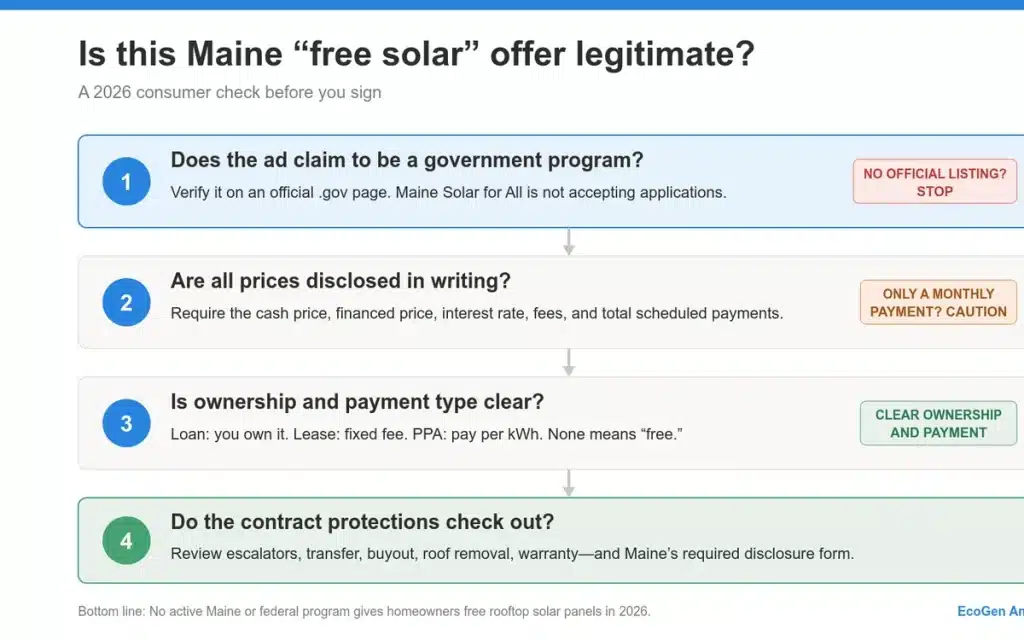
How to Verify a “Free Solar” Offer in Maine
Some $0-down products are legitimate. An offer becomes misleading when it presents a long-term obligation as a government giveaway, hides ownership, or avoids disclosing the complete cost.
Government-Program and Advertising Red Flags
The Maine Attorney General warns that Maine is not requiring homeowners to convert to solar and has not selected particular towns or neighborhoods for free installations. Other red flags include:
- Requests for Social Security numbers or utility credentials before the offer is explained
- Pressure to sign immediately
- A promise to eliminate the entire CMP or Versant bill
- A 30% homeowner credit shown for a system completed in 2026
- Refusal to provide cash and financed prices separately
- Claims of representing CMP, Versant, Maine, or the federal government without proof
🛑 Cancellation right: If a company solicited you and you did not initiate the contact, the Maine Attorney General says you generally have three business days to cancel after signing. The company must disclose that right and cannot require you to waive it.
The U.S. Department of Energy also states that the federal government does not provide free home solar installations. Verify income-qualified programs on an official .gov website before sharing personal information.
Ask for Maine’s Required Solar Disclosure Form
Maine law requires companies selling or leasing customer-side solar equipment to provide a completed standard written disclosure that you can keep. The state publishes separate forms for solar ownership and solar leasing.
Do not sign until the price, ownership, payment, equipment, warranty, and transfer terms on the disclosure match the proposal and contract.
Compare Cash and Financed Prices
A large gap between the two prices can indicate a dealer or platform fee. The Consumer Financial Protection Bureau has warned about misleading “net cost” presentations and hidden financing charges.
Request these figures in writing:
- Cash price
- Financed price
- Interest rate and term
- Dealer or platform fee
- Total of all scheduled payments
Check the PPA Escalator
Most PPAs increase the contract rate by 1% to 5% per year. Request projected payments for year 1, year 10, and year 25, then compare them with more than one reasonable utility-rate scenario.
Review Transfer, Buyout, and Warranty Terms
Confirm what happens if the home is sold, the buyer does not qualify, the roof needs replacement, or the provider stops operating. Review the early buyout price, roof-removal cost, equipment models, production guarantee, and responsibility for repairs.
The FTC Holder Rule (16 CFR §433.2) may provide limited recourse when a financed installer fails to deliver. Maine electrical work must be performed by a licensed electrician; see how to vet Maine solar installers for additional screening criteria.
Ten Steps Before You Sign
- Gather 12 months of electricity usage. Compare proposals using kWh, not only dollar totals.
- Identify the utility and rate plan. Confirm whether the account is with CMP, a Versant district, a municipal utility, or a co-op.
- Obtain at least three written proposals. Compare equivalent system sizes and production assumptions.
- Request cash and financed prices separately. Do not accept a quote showing only a monthly payment.
- Request Maine’s disclosure form. Confirm that its price, ownership, equipment, warranty, and transfer terms match the contract.
- Calculate the complete monthly cost. Include the solar payment and remaining utility charges.
- Verify the provider. Check electrician licensing and, for community solar, Maine PUC registration.
- Review long-term terms. Confirm escalators, buyout prices, roof-removal charges, and warranties.
- Document cancellation rights. Keep a complete signed copy and record how the company contacted you.
- Verify government claims independently. Use a
.govwebsite or call the named agency rather than relying on the advertisement’s contact information.
When Free Solar Panels in Maine Are Not Worth It
Some households should wait or walk away, even with high rates and $0 upfront.
- The household uses less than 300 kWh per month. A minimum practical system may produce more than the home uses, while credits expire after 12 months and fixed charges remain.
- A move is likely within five years. A loan balance, lease transfer, or PPA transfer can complicate the sale.
- The roof needs near-term replacement. Removing and reinstalling panels adds a cost that may not appear in the proposal.
- The contract relies on aggressive assumptions. Savings can disappear when production, utility inflation, or resale projections are unrealistic.
- The complete solar cost does not beat the utility bill. If the combined total is higher, the offer does not create immediate savings.
⚠️ Simple Test: A $0-down offer is not a good deal merely because it receives approval. It should lower your total energy cost under realistic production and contract assumptions.
See If $0-Down Solar Fits Your Maine Home
Maine’s high rates and strong rooftop net energy billing can make $0-down solar work for some households. The result depends on your utility, roof, electricity use, credit terms, ownership structure, and complete contract cost.
This is not a government application. Entering your ZIP code may connect you with private solar providers offering loans, leases, or PPAs. Approval and savings are not guaranteed, so compare multiple written offers before choosing a provider.
Find out if you're eligible for $0-down solar in Maine!
FAQs About Free Solar Panels in Maine
No. There is no active government program giving Maine homeowners free rooftop panels. “Free solar” normally means a loan, lease, or PPA with no upfront payment.
No. The program was expected to help income-qualified households, but the EPA terminated Maine’s $62 million award in August 2025. There is no active homeowner application as of July 2026.
Credits may appear on your utility account even when the provider owns the equipment. The lease or PPA determines what the provider charges and how much of the bill value becomes savings.
Usually not. Fixed charges remain, and you may also owe a loan, lease, PPA, or community-solar payment.
Ownership generally offers the highest potential long-term value, a lease shifts maintenance to the provider, and a PPA charges for production. The best option has the lowest realistic total cost over the time you expect to remain in the home.
The homeowner Section 25D credit is unavailable for systems completed in 2026, Maine has no state solar rebate, and the general 5.5% sales tax applies. Maine’s property-tax exemption can still benefit homeowners who own qualifying equipment.
Both utilities support residential net energy billing, but delivered rates differ. As of July 1, 2026, the rate was 24.58¢/kWh for CMP, 30.35¢/kWh for Versant Bangor Hydro, and 29.66¢/kWh for Versant Maine Public.
A loan may need to be addressed at closing. A lease or PPA may require buyer qualification, contract transfer, or an early buyout. Review those provisions before signing.
References & Research Sources
EcoGen America reviewed Maine Solar for All updates, consumer warnings about “free solar” claims, net energy billing rules, community solar resources, federal tax changes, Maine solar tax exemptions, battery incentives, contractor licensing, solar rights law, and federal electricity data for this Free Solar Panels in Maine guide. Sources were accessed July 21, 2026, unless another publication, release, effective, or update date is listed below.
- Maine Department of Energy Resources. Solar for All. Maine Solar for All status resource, including the department’s statement on the U.S. EPA termination of Maine’s Solar for All award. Published August 8, 2025. Accessed July 21, 2026.
- Office of the Maine Attorney General. Solar Advertisements Advisory. Consumer advisory on misleading solar panel advertisements and “free solar” claims. Published October 16, 2024. Accessed July 21, 2026.
- U.S. Department of Energy (DOE). Free Solar Panels? Don’t Get Burned. Consumer guidance on “free solar panel” claims and solar scams. Published April 26, 2023. Accessed July 21, 2026.
- Maine Public Utilities Commission (MPUC). Residential Electric Rates. Maine residential electric delivery and supply rate resource, including average residential electric rates by utility. Accessed July 21, 2026.
- Maine Public Utilities Commission (MPUC). Net Energy Billing. Maine net energy billing program resource for distributed generation customers and eligible facilities. Accessed July 21, 2026.
- Maine Office of the Public Advocate. Community Solar. Consumer resource on Maine community solar subscriptions, customer protections, and solar provider considerations. Accessed July 21, 2026.
- Maine Legislature. 35-A M.R.S. § 3209-A: Net Energy Billing. State net energy billing statute for distributed generation resources. Accessed July 21, 2026.
- Maine Legislature. 36 M.R.S. § 1760: Exemptions. Maine sales and use tax exemption statute. Accessed July 21, 2026.
- Internal Revenue Service (IRS). FAQs for Modification of Sections 25C, 25D, 25E, 30C, 30D, 45L, 45W, and 179D Under Public Law 119-21. Fact Sheet FS-2025-05. Published August 21, 2025. Accessed July 21, 2026.
- U.S. Congress. H.R.1: An Act to Provide for Reconciliation Pursuant to Title II of H. Con. Res. 14. Public Law No. 119-21, commonly known as the One Big Beautiful Bill Act. Became law July 4, 2025. Accessed July 21, 2026.
- Maine Revenue Services. Property Tax Bulletin No. 29: Solar Energy Equipment Exemption. Property Tax Division guidance on Maine’s solar energy equipment property tax exemption. Revised December 30, 2024. Accessed July 21, 2026.
- Efficiency Maine. Small Battery Incentives. Battery incentive and demand-response resource for eligible residential battery storage systems. Accessed July 21, 2026.
- Consumer Financial Protection Bureau (CFPB). Solar Financing. Issue Spotlight report on residential solar financing, solar-specific loans, leases, and consumer risks. Published August 7, 2024. Accessed July 21, 2026.
- Federal Trade Commission (FTC). 16 CFR Part 433: Preservation of Consumers’ Claims and Defenses. Federal Holder Rule regulation, including 16 CFR § 433.2. Accessed July 21, 2026.
- Maine Legislature. Title 33, Chapter 28-A: Solar Rights. Maine solar rights statute, including provisions related to legal instruments affecting residential solar energy devices. Accessed July 21, 2026.
- Maine Office of Professional and Occupational Regulation. Electricians’ Examining Board. Electrical licensing and professional regulation resource for Maine electricians. Accessed July 21, 2026.
- National Renewable Energy Laboratory (NREL). PVWatts Calculator. Solar photovoltaic energy production modeling tool. Accessed July 21, 2026.
- U.S. Energy Information Administration (EIA). Electric Power Monthly. Federal electricity generation, sales, revenue, and price data resource, including average retail electricity price tables by state and sector. Accessed July 21, 2026.
- Maine Department of Energy Resources. Solar. Maine solar resource, including Solar Customer Disclosure Forms, net energy billing overview, community solar guidance, and consumer information for solar customers. Accessed July 21, 2026.


